

The first-ever FAA ground stop in US history was on 9/11: Here's how it unfolded
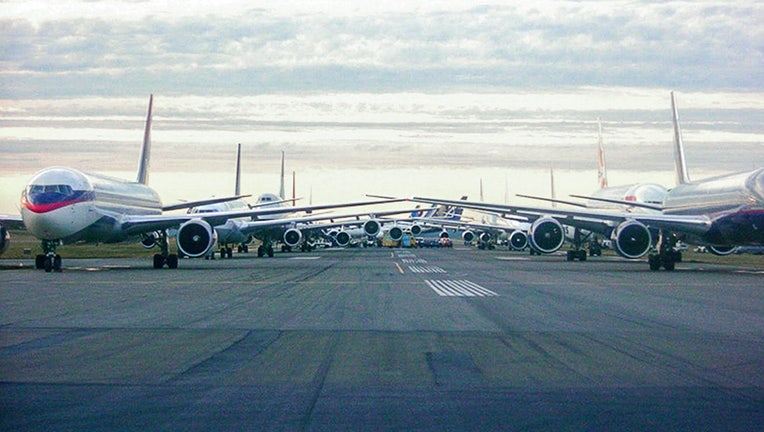
On Sept. 11, 2001, 40 planes with 8,000 passengers landed at Halifax Stanfield International Airport as part of Operation Yellow Ribbon. (Halifax International Airport Authority)
The terrorist attacks on Sept. 11, 2001, prompted the Federal Aviation Administration to order an unprecedented nationwide ground stop for all aircraft operating in U.S. airspace.
Friday's ground stop amid a communication outage is only the second since that day. Here's how the first one unfolded.
Timeline:
At 9:06am, the FAA issued a ground stop to all traffic that had not yet departed that would encounter New York City airspace and redirected inbound traffic away from NYC. A warning was issued to all airplanes in the air of potential cockpit intrusion.
At 9:45am, at the direction of Transportation Secretary Norman Mineta, the FAA Command Center closed all U.S. airspace for the first time in history. At the time of the issuance of the nationwide ground stop, the FAA says there were more than 4,500 aircraft in the air.
Air Traffic Controllers were able to safely land 700 aircraft within four minutes of the order, 2,800 in the first hour, and over 4,500 within the first three hours, resulting in over a million passengers landing safely.
Airplanes en route to the United States from international locations either returned to their point of departure or, due to not having enough fuel to return to their departure airport, were diverted to airports in Canada.
Three-and-a-half hours later, at 12:16 p.m., U.S. airspace was clear of all commercial and private flights.
NASA animation of the FAA closure of US Airspace on 9/11
Utilizing FAA air traffic control data from September 11, 2001, NASA created this animation of the rapid grounding of air traffic across the US and the redirection of incoming international traffic.
Canada’s Operation Yellow Ribbon on 9/11 safely landed over 200 planes
Following the FAA’s closing of U.S. airspace, Canada initiated "Operation Yellow Ribbon" to manage over 200 civilian flights with more than 33,000 passengers on board and divert them from U.S. airspace to Canada.
By the numbers:
Transport Canada, the Canadian federal government department that sets and enforces national aviation safety regulations, reported that 224 flights were diverted to 17 Canadian airports, while NAV Canada, a private, not-for-profit corporation that operates Canada's air traffic control and navigation services, said 238 flights were diverted to Canadian airports, some of them small ones, with the majority landing at Gander International Airport, Halifax Stanfield International Airport, and St. John's International Airport, as well as Vancouver International Airport for inbound transpacific flights.
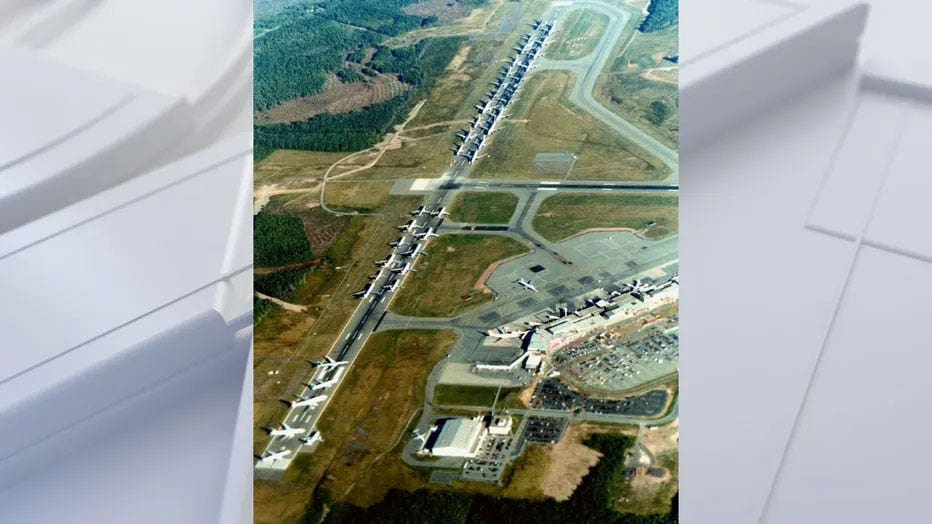
An aerial view of the Halifax Stanfield International Airport runway on September 11, 2001, after 40 planes and 8,000 passengers landed as part of Operation Yellow Ribbon. (Halifax International Airport Authority)
At Halifax Stanfield International Airport in Goffs, Nova Scotia, 40 diverted planes carrying approximately 8,000 passengers and crew landed safely as part of Operation Yellow Ribbon.
In Newfoundland, 38 planes with nearly 7,000 stranded passengers and crew landed at Gander International Airport – a town with a population of just under 10,000, leaving Gander and the surrounding areas with the problem of how to accommodate the passengers as they did not have enough hotel space for the thousands of stranded passengers.
That’s when local residents stepped up. Community television stations put out a call to "lend a hand, do what you can," according to the National September 11 Memorial & Museum. Schools and nonessential businesses closed to allow residents to volunteer.
"Greeting the ‘plane people’ with warmth, locals provided meals, clean bedding, and hot showers," the National September 11 Memorial & Museum states. "Schools, churches, and legion halls were converted into makeshift dormitories.
Pharmacies in the area filled prescriptions for free for those who needed medication, banks of free public telephones were installed so stranded passengers could make phone calls, and many donated toiletries, clothing, and food, the organization said.
A lot of the food was stored at the Gander Community Centre’s ice rink, turning it into "the largest walk-in freezer in the country," Gander’s mayor, Claude Elliott, was quoted as saying.
The National September 11 Memorial & Museum said residents also worked to entertain their visitors, organizing tours of the town, bowling matches, concerts by local bands, and introducing them to regional cuisine.
On Thursday, Sept. 13, U.S. airspace was reopened for limited commercial service and the airport reopened with significantly heightened security checks. Due to security concerns surrounding the nation's capitol, flights at Ronald Reagan Washington National Airport didn’t resume until October 4, 2001.
Air Traffic Control recognized for their efforts
A week after the attacks, Bill Peacock, director of air traffic at the FAA, thanked all the Air Traffic Control employees, saying in a memo:
"During the past week, the Air Traffic organization has demonstrated great strength and purpose. You have given of yourselves to fulfill the mission of our agency, the needs of the flying public and the safety of America."
National Air Traffic Controllers Association President Emeritus John Carr called it a historical moment for the Air Traffic Control community.
"The landing of those aircraft stands as the single greatest feat in all of ATC history," he said.
Dig deeper:
The FAA issued a ground stop for all flights late Friday afternoon because of a "temporary telecommunications outage." Federal authorities have not yet specified the nature of the outage or the cause.
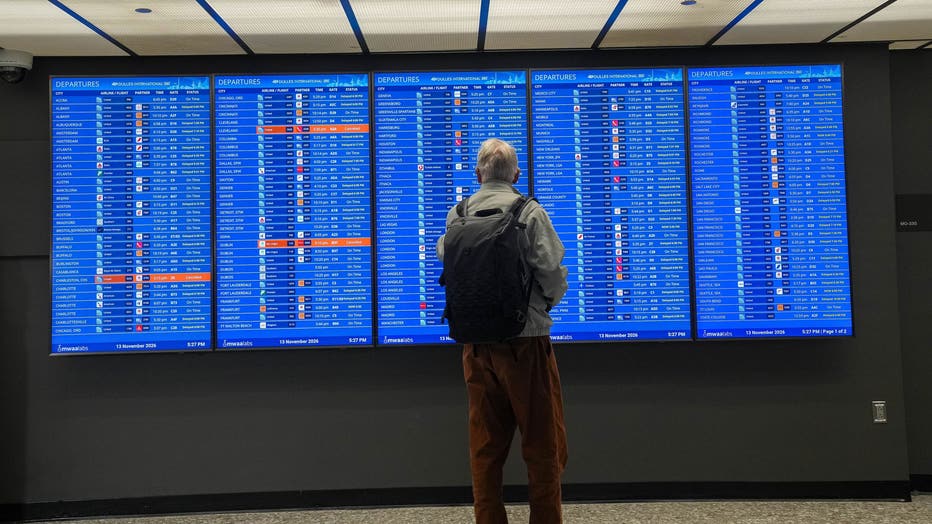
Washington Dulles International Airport is seen in Virginia on November 13, 2026, amid a nationwide ground stop affecting airports across the United States. Nearly 7,000 flights have been delayed or canceled nationwide. (Photo by Mehmet Eser/Anadolu
Shortly after 5 p.m., the FAA said on X that all flights had been accounted for and international flights would be handled on a case by case basis.
U.S. Department of Homeland Security Secretary Markwayne Mullin said that for the public, there was "no reason to be concerned" about loved ones.
"Everybody's safe," he said. "I just want to make sure everybody's at ease about that as we investigate what caused this. You always got to assume that as many cyber attacks that take place that you make that assumption. So, but as of right now, that's not known."
Before Friday, the last time the FAA issued a ground stop was on Jan. 11, 2023. That stop, which halted all domestic flight departures because of a failure of its Notice to Air Missions safety system.
Unlike 9/11, the 2023 and 2026 ground stops only affected departing flights. The Sept. 11, 2001, ground stop became a full closure of U.S. airspace, meaning flights already in the air were diverted to the nearest airport for immediate landings.
The Source: This article includes information from the National September 11 Memorial & Museum, The Federal Aviation Administration, the National Air Traffic Controllers Association, Transport Canada, NAV Canada, the Smithsonian National Air and Space Museum, and previous FOX Local reporting. This story was reported from Orlando.