

Who is Nicolás Maduro? Venezuelan president captured by US forces

Venezuela’s President Nicolás Maduro and his wife, Cilia Flores, were captured by U.S. forces in Caracas Saturday.
Maduro’s capture was announced by President Donald Trump in an early morning social media post, while Attorney General Pam Bondi later said that Maduro and Flores would face charges in the U.S. after an indictment in New York.
Explosions and low-flying aircraft were reported Saturday across Caracas, Venezuela’s capital, with power outages in parts of the city. Maduro’s fall was the culmination of months of stepped-up U.S. pressure on various fronts.
Trump is holding a press conference to discuss the Venezuela military operation at 11 a.m. ET Saturday. You can watch it live on LiveNow from FOX or in the media player above. Click here for the latest on Maduro’s capture and the military attack in Venezuela.
Who is Nicolás Maduro?
The backstory:
Maduro’s meteoric rise from unionized bus driver to the president who oversaw Venezuela’s economic collapse began 40 years ago. He’s the head of a so-called socialist revolution that his late predecessor, Hugo Chávez, ushered in 1999. Maduro, like Chávez, sees the United States as Venezuela’s biggest threat and has forcefully resisted efforts to restore democracy in the South American nation.
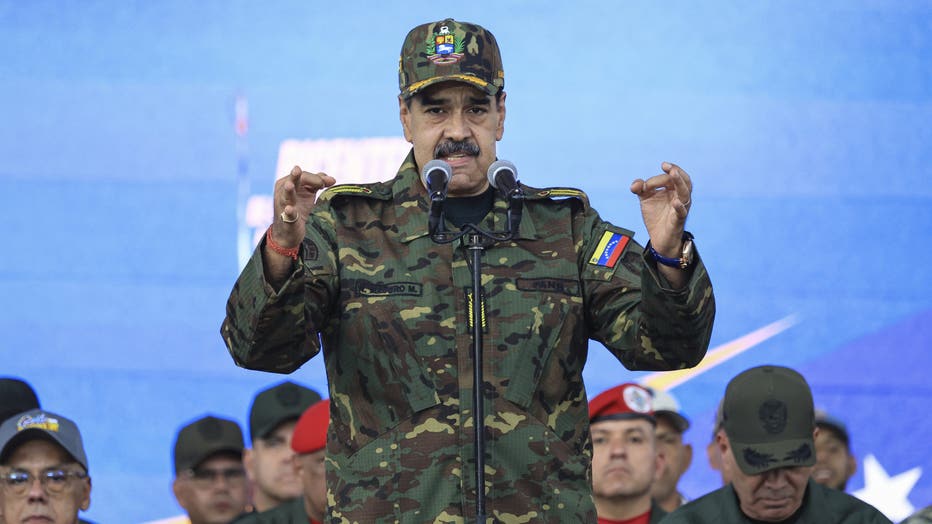
President of Venezuela Nicolás Maduro speaks during a military ceremony commemorating the 200th anniversary of the presentation of the 'Sword of Peru' to Venezuelan independence hero Simón Bolívar on November 25, 2025, in Caracas, Venezuela.(Photo by
In 1986, Maduro traveled to Cuba to receive a year of ideological instruction, his only formal education after high school. Upon his return, he worked as a bus driver for the Caracas subway system, where he quickly became a union leader. Venezuela’s intelligence agencies in the 1990s identified him as a leftist radical with close ties to the Cuban government.
Maduro eventually left his driver job and joined the political movement that Chávez organized after receiving a presidential pardon in 1994 for leading a failed and bloody military coup years earlier. After Chávez took office, the former youth baseball player rose through the ranks of the ruling party, spending his first six years as a lawmaker before becoming president of the National Assembly. He then served six years as foreign minister and a couple months as vice president.
Chávez used his last address to the nation before his death in 2013 to anoint Maduro as his successor, asking his supporters to vote for the then-foreign affairs minister should he die. The choice stunned supporters and detractors alike. But Chávez’s enormous electoral capital delivered Maduro a razor-thin victory that year, giving him his first six-year term. He’s never been as popular as Chávez.
The first Trump administration imposed economic sanctions against Maduro, his allies and state-owned companies to try to force a government change. Maduro was indicted in March 2020 on U.S. charges related to narco-terrorism. The U.S. government has accused Maduro of running the Cartel de los Soles. In August, the U.S. announced a $50 million reward for information leading to Maduro’s arrest.
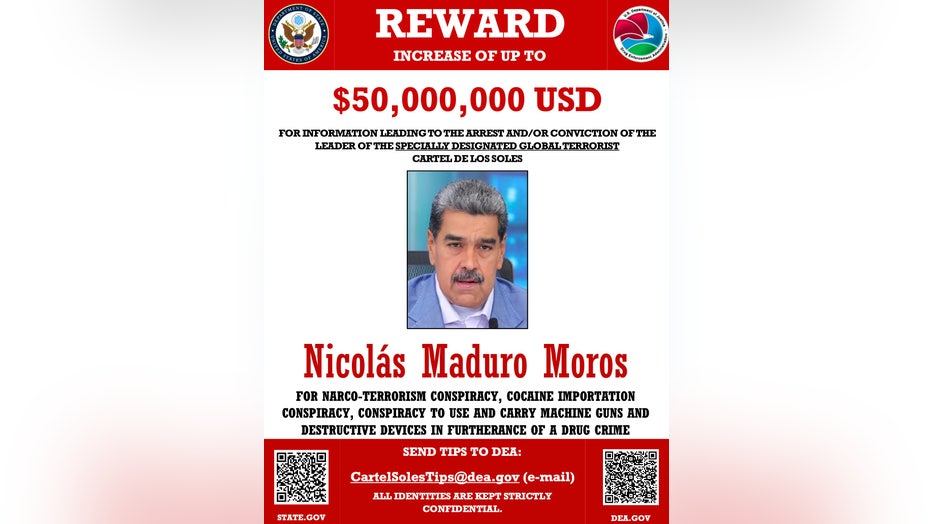
Wanted poster released by US government in August 2025
The latest indictment, released Saturday by the Justice Department, accuses Maduro of leading "a corrupt, illegitimate government that, for decades, has leveraged government power to protect and promote illegal activity, including drug trafficking." It alleges that the drug trafficking efforts "enriched and entrenched Venezuela’s political and military elite."
U.S. authorities allege that Maduro partnered with "some of the most violent and prolific drug traffickers and narco-terrorists in the world" to bring tons of cocaine into the U.S., according to the indictment.
Authorities estimate that as much as 250 tons of cocaine were trafficked through Venezuela by 2020, according to the indictment. The drugs were moved on go-fast vessels, fishing boats and container ships or via planes from clandestine airstrips, authorities allege.
Maduro’s presidency marked by crisis
By the numbers:
Millions of Venezuelans were pushed into poverty under Maduro’s rule, with more than 7.7 million Venezuelans migrating to other countries during his presidency. Entire families starved and began migrating on foot to neighboring countries. Those who remained lined up for hours to buy rice, beans and other basics. Some fought on the streets over flour.
He has imprisoned and tortured thousands of real or perceived government opposers since taking office. More than 100 people were killed and thousands were injured in the demonstrations. Hundreds were arrested, causing the International Criminal Court to open an investigation against Maduro and members of his government for crimes against humanity. The investigation was still ongoing in 2025.
Under Maduro’s watch, Venezuela’s economy shrank 71% between 2012 and 2020, while inflation topped 130,000%. Its oil production, the beating heart of the country, dropped to less than 400,000 barrels a day, a figure once unthinkable.

Venezuela's Manduro, wife facing prosecution in US
Attorney General Pam Bondi says Venezuelan President Nicolas Maduro and his wife, Cilia Flores, had both been indicted in narco-terrorism charges following military strikes in Venezuela. Bondi’s statement came after President Trump announced the capture of Maduro and Flores. Bondi said Maduro would face charges of narco-terrorism conspiracy, cocaine importation conspiracy, possession of machineguns and destructive devices and conspiracy to possess machineguns and destructive devices against the United States.
Maduro began implementing a series of economic measures in 2021 that eventually ended Venezuela’s hyperinflation cycle, and also restarted negotiations for what many had hoped would be a free and democratic presidential election in 2024.
Maduro used the negotiations to gain concessions from the U.S. government, including the sanctions license that allowed oil giant Chevron to restart pumping and exporting Venezuelan oil. The license became his government’s financial lifeline.
In early 2024, it became clear that Venezuela would not see a democratic presidential election, as Maduro’s regime intensified its repressive efforts. Maduro detained opposition leaders and human rights defenders.
Hours after polls closed in the 2024 election, the National Electoral Council declared Maduro the winner. But unlike previous elections, it did not provide detailed vote counts. The opposition, however, collected and published tally sheets from more than 80% of electronic voting machines used in the election. The records showed Edmundo González defeated Maduro by a more than 2-to-1 margin.
World leaders rejected the official results, but the National Assembly swore in Maduro for a third term in January 2025. Trump returned to the White House the same month, in what would become the beginning of the end for Maduro.
Who is Cilia Flores?
Dig deeper:
Maduro married Flores, his partner of nearly two decades, in July 2013, shortly after he became president. He called her the "first combatant," instead of first lady, and considered her a crucial adviser.
The Source: This report includes information from The Associated Press.