

Proposal would limit Social Security benefits to $100K a year for wealthy couples

Social Security tax cuts could impact young Americans
A new report shows the cost of stabilizing the Social Security program could cost young taxpayers over the course of their careers.
As Social Security barrels toward broke in less than seven years, a Washington think tank has proposed limiting benefits to $100,000 a year for couples.
The "Six Figure Limit," written by the centrist Committee for a Responsible Federal Budget, would also cap Social Security payments at $50,000 a year for a single person. Here’s what to know:
Why is Social Security going broke?
Big picture view:
Social Security’s trust fund is on track to run out of reserves by late 2032, in part because the new tax provisions under President Trump’s One Big Beautiful Bill Act reduced revenue to the trust fund, speeding up depletion.
When the trust fund is emptied, federal law requires that payments be limited to incoming payroll taxes, triggering an automatic 24% benefit cut for retirees unless Congress acts.
RELATED: Social Security recipients could see $18,000 cut in benefits by 2032, analysis warns
What they're saying:
"Social Security has been on a path toward insolvency for some time – but over the past year, politicians have made its financial condition even worse," CRFB wrote in past reports.
Republicans and Democrats agree that reforms are needed to save the program, but they so far haven’t agreed on a solution. Democrats have proposed raising Social Security taxes on the wealthiest Americans (Americans pay Social Security taxes only on up to $168,000 a year). Republicans, meanwhile, have floated the idea of raising the retirement age and generally oppose raising taxes to fund Social Security.
RELATED: Social Security March payment schedule: Here’s when recipients get their checks
Social Security advocates say there are essentially two solutions for fixing Social Security:
"Pay more or get less," Kathleen Romig, director of Social Security and disability policy at the Center on Budget and Policy Priorities, told the Associated Press.
The ‘Six Figure Limit’ on Social Security
Big picture view:
Currently, only the wealthiest retired couples top $100,000 in Social Security benefits annually. But that’s expected to change as more people retire in coming years.
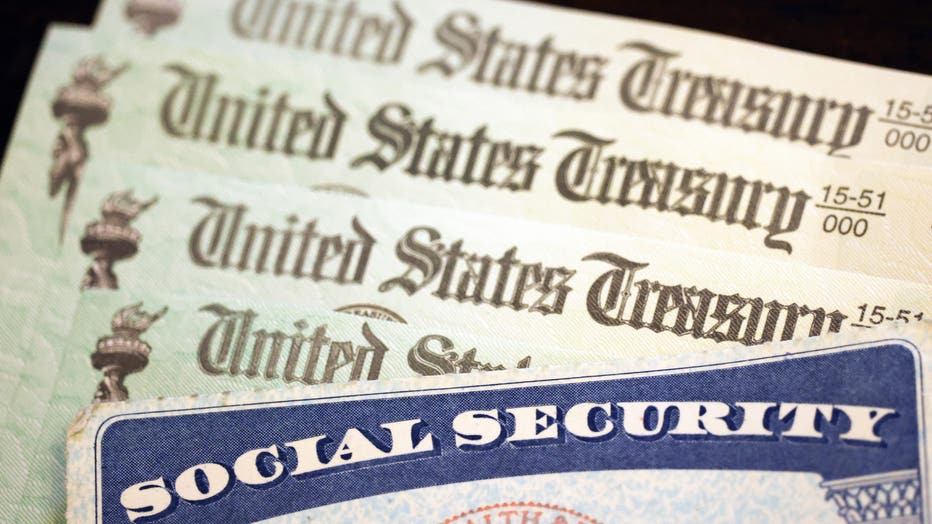
FILE - A new proposal would cap Social Security benefits for the wealthiest retirees (Photo illustration by Kevin Dietsch/Getty Images)
"Although only a tiny fraction of couples will enjoy such generous benefits in the near term, six-figure benefits will become increasingly common over time," the CRFB notes.
By the numbers:
According to the Social Security Administration, if you retire at 67 in 2026, your maximum monthly payment would be $4,152. If you retire at 62 in 2026, your top benefit would be $2,969. If you retire at 70 in 2026, your max benefit would be $5,181.
Under the "Six Figure Limit" proposal, a couple who both retired at 70 would be limited to $124,000 a year in Social Security, while a couple who both began collecting benefits at age 62, the minimum retirement age, would be capped at $70,000 a year. Limits would vary depending on when each spouse began collecting benefits.
According to the paper’s authors, capping benefits for the wealthiest Social Security recipients would save $100 billion to $190 billion over a decade if the policy took effect this year – and boost benefits for the bottom 70% to 80% of beneficiaries.
"This is for people who already have millions and tens of millions in assets," said Marc Goldwein, senior policy director at CRFB, told USA Today.
What is Social Security?
The backstory:
The Social Security program started in 1935 as a safety net for the nation’s oldest and most vulnerable. President Franklin Roosevelt signed it into law.
When you work, some of your taxes fund Social Security. The government uses those tax dollars to pay benefits to people who have already retired, people who are disabled, the survivors of workers who have died, and dependents of beneficiaries.
RELATED: Social Security has a 'billionaire problem,' advocate warns
While the money is used to pay people currently getting benefits, any unused money goes to the Social Security trust fund. When you retire, the Social Security contributions of people in the workforce, together with the money in the fund, will pay monthly benefits to you and your family. If the trust fund runs out, Social Security would be funded solely by payroll taxes unless Congress takes action.

Trump on Social Security, 401k during State of the Union
Trump announced a plan to give workers without employer retirement plans a 401k match up to $1,000.
"So they basically pre-funded their retirement – people paid in more into Social Security than was necessary to pay current benefits because it's a pay-as-you-go system, so your money doesn't go to a bank account and wait for you and then you get it when you retire," Social Security Works Executive Director Alex Lawson told FOX Local in 2024.
To determine the Social Security benefits you will receive, the government calculates a percentage of your highest wages in your top 35 years of earning, and factors in when you choose to start receiving benefits.
What’s the retirement age for Social Security?
Benefits can be claimed as early as age 62, but they are reduced, and this reduction in benefits is permanent. Waiting until your full retirement age (FRA) of 67 provides 100% of your eligible benefit. For each year past your FRA, your monthly benefit increases by 8% annually until it maxes out at age 70.
The Source: This article includes information from the Committee for a Responsible Federal Budget, Social Security Works, USA Today, the Social Security Administration, The Associated Press and previous FOX Local reporting.