

Students in these states spend more of their income on education, according to analysis
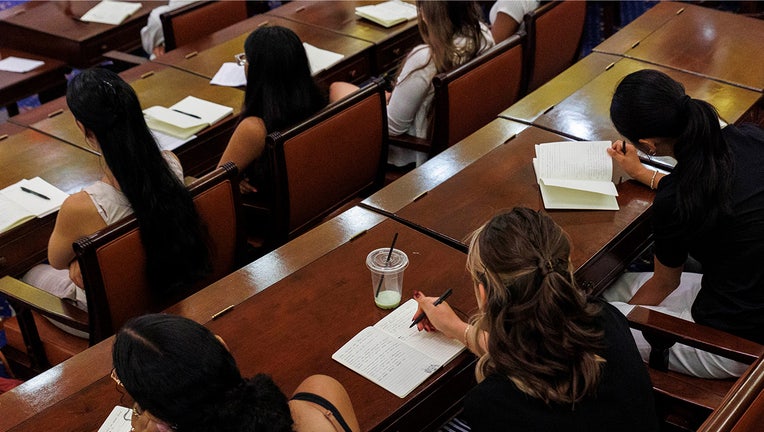
FILE - Students in the Kennedy-Breyer Civics Scholars program listen and take notes as Massachusetts U.S. Senator Ed Markey delivers remarks over video call inside the Senate chamber at the Edward M. Kennedy Institute on July 29, 2025. (Photo by Ben
Pursuing a higher education can get expensive and a recent analysis from WalletHub found the states where students spent the most and least on going to college.
WalletHub factored in the price of in-state undergraduate tuition, room and board, and adjusted figures for the median annual income in each state.
Here’s a look at the most and least expensive states to get a college education:
Pennsylvania spent the most on education
Dig deeper:
Topping off the list was Pennsylvania, with residents spending an average of $55,144 a year on getting a higher education, according to WalletHub, which was about 72.5% of the median household income.
Pennsylvania also has some reputable schools, such as University of Pennsylvania, Carnegie Mellon University, Temple University and many more.
Next was Rhode Island at $61,458 and New York at $57,788.
Many of the states that made the top 10 were home to other renowned, and albeit expensive, schools such as Harvard University, Yale, Columbia and many more.
Do college degrees have a positive return on investment?
Big picture view:
A wide body of research indicates a bachelor’s degree still pays off, at least on average and in the long run. Yet there’s growing recognition that not all degrees lead to a good salary, and even some that seem like a good bet are becoming riskier as graduates face one of the toughest job markets in years.
An analysis released in October by the Strada Education Foundation found 70% of recent public university graduates can expect a positive return within 10 years — meaning their earnings over a decade will exceed that of a typical high school graduate by an amount greater than the cost of their degree.
Yet it varies by state, from 53% in North Dakota to 82% in Washington, D.C. States where college is more affordable have fared better, the report said.
Last year Burning Glass Institute, a think tank that studies the workforce, partnering with Strada researchers, found 52% of recent college graduates were in jobs that didn’t require a degree. Even higher-demand fields, such as education and nursing, had large numbers of graduates in that situation.
The federal government has been trying to fix the problem for decades, going back to President Barack Obama’s administration. A federal rule first established in 2011 aimed to cut federal money to college programs that leave graduates with low earnings, though it primarily targeted for-profit colleges.
Others see transparency as a key solution.
For decades, students had little way to know whether graduates of specific degree programs were landing good jobs after college. That started to change with the College Scorecard in 2015, a federal website that shares broad earnings outcomes for college programs. More recently, bipartisan legislation in Congress has sought to give the public even more detailed data.
Lawmakers in North Carolina ordered a 2023 study on the financial return for degrees across the state’s public universities. It found that 93% produced a positive return, meaning graduates were expected to earn more over their lives than someone without a similar degree.
The data is available to the public, showing, for example, that undergraduate degrees in applied math and business tend to have high returns at the University of North Carolina at Chapel Hill, while graduate degrees in psychology and foreign languages often don’t.
The Source: Information for this article was taken from a WalletHub study and previous reporting by The Associated Press.