

Americans want a third party but won't support it, poll suggests
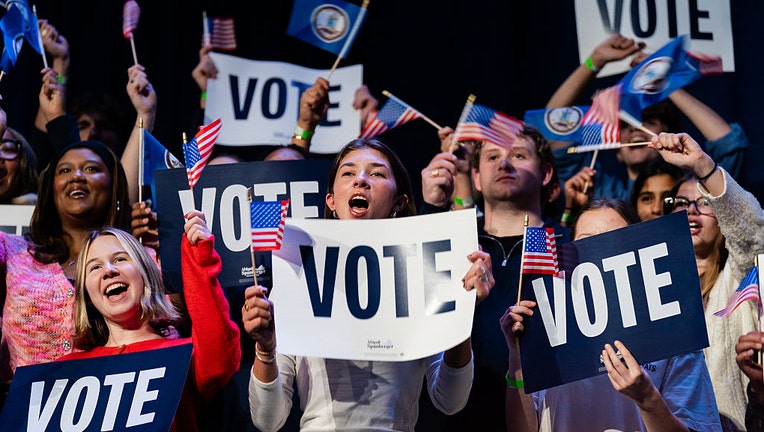
FILE-Attendees hold vote signs during a campaign event in Charlottesville, Virginia, on Tuesday, Oct. 21, 2025. (Carlos Bernate/Bloomberg via Getty Images)
Americans believe that a third party candidate is needed, but don’t feel strongly committed to voting for one in an election.
Approximately 55% of respondents say they are least "somewhat likely" to vote for third party candidates, only 15% say they are "very likely" to do so, according to a new Gallup poll.
RELATED: These states are most affected by government shutdown, analysis shows
The analytics and advisory company published results from a poll using telephone interviews conducted by ReconMR between Sept. 2-16, 2025, with a sample of 1,000 people 18 years old and older, living in the U.S.
Americans want a third-party candidate given the job performance of other political parties
Why you should care:
Gallup noted 83% of Americans who don’t support the Republican and Democratic parties think a third party is needed. But even 54% of those who view one or both political parties favorably agree.
Seventy percent of respondents under age 50 support a third party, compared with 61% of people between the ages of 50 and 64 and 48% of individuals 65 years old and older.
RELATED: Here's who Americans blame for government shutdown, according to poll
Meanwhile, 74% of independents, 58% of Democrats and 43% of Republicans favor having a third-party.
However, when Americans were asked how they would vote if a third party candidate they preferred was unlikely to win, more people admitted they would switch their vote instead of sticking with that candidate.
More than half of respondents worry about the outcomes of voting for a third party candidate
Dig deeper:
The poll revealed that most Americans expressed worry about the implications of voting for a third-party candidate. Approximately 57% admit they are "extremely" or "very" concerned about wasting their vote on a candidate with no legitimate chance of winning an election, while another 26% are "moderately" concerned.
And another 59% of people acknowledge they are extremely or very concerned about helping their least favorite candidate win the election, with another 23% admitting to being moderately worried.
Separately, independents share in the survey that they are less likely to have concerns about consequences of voting for a third party candidate, but nearly 50% of them still do. Gallup found that Democrats are more likely than Republicans to express worries about supporting a third-party candidate.
But adults between the ages of 18 and 29 are also unlikely to worry about the results of voting for a third party candidate. But two-thirds of older Americans fear possible negative outcomes of casting a third-party vote.
The Source: Information for this story was provided by a Gallup poll, which used telephone interviews conducted by ReconMR between Sept. 2-16, 2025, with a sample of 1,000 people 18 years old and older, living in the U.S. This story was reported from Washington, D.C.