

Vaccination rates for US students entering kindergarten fall as exemptions climb to a new high
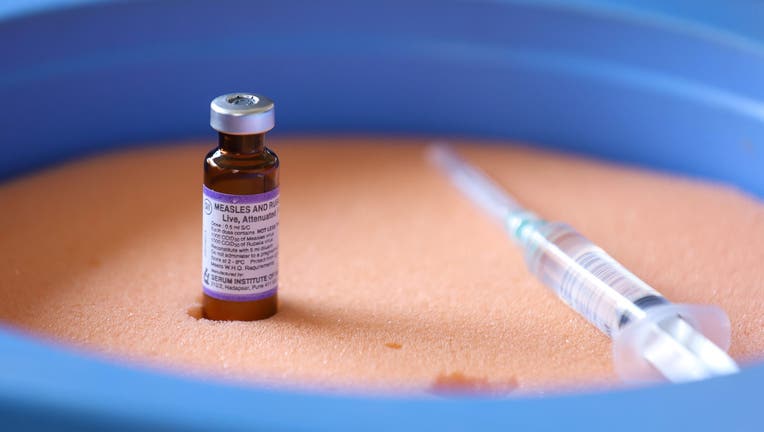
FILE - A vial containing the measles-rubella vaccine (Photo by Subaas Shrestha/NurPhoto via Getty Images)
Vaccination rates for U.S. children entering kindergarten during the 2025-2026 school year decreased according to new data released by the Centers for Disease Control and Prevention (CDC), with vaccination exemptions hitting a record high.
By the numbers:
The CDC says for the 2025-2026 school year, the vaccination rates were 92.0% for diphtheria, tetanus, and acellular pertussis vaccine (DTaP) to 92.4% for measles, mumps, and rubella vaccine (MMR) and polio vaccine compared to the 2004-2025 school year.
For the 2025-2026 school year, the CDC says the number of kindergartners attending school without documentation of completing the MMR vaccine series was about 280,000.
The CDC says the decrease in student vaccination rates is due to an increase in vaccine exemptions. The report shows that during the 2025-2026 school year, exemptions for one or more vaccines among kindergartners increased to a record high 4.2% from 3.6% the year before, with exemptions increasing in 41 states and the District of Columbia, and 24 states reporting exemptions exceeding 5%.
There were 155,000 kindergartners who were exempt from one or more vaccines during the 2025-2026 school year, according to the CDC.
Dig deeper:
Last week, President Trump signed an executive order calling for fewer childhood vaccinations by limiting the inoculation schedule to 11 immunizations. The order also recommended splitting the measles, mumps and rubella vaccine into three shots taken at separate visits.
What they're saying:
Medical professionals point to a resurgence in diseases like measles, with only 92 percent of kids getting the MMR shot last year — below the 95 percent threshold needed to maintain herd immunity.
"We don't really have herd immunity for anything anymore. And so you've got to build immunity in your own little personal herd. That's your family," said Ben Neuman, PhD, Texas A&M University virologist.
Some states fared better than others when it came to the combined MMR shot. Texas, which had a severe measles outbreak last year prior to the new CDC data report, saw MMR rates stay the same at 93.2%, and improving compared to previous time periods.
California dropped 0.4 points to 95.7%, more than any year since the COVID-19 pandemic.
According to the CDC data, West Virginia, Connecticut, Maine, New York and Mississippi had the highest vaccination rates for the MMR vaccine, while Idaho, Wisconsin, Minnesota, Utah and Arizona had the lowest rates.
The Source: This article includes information from the Centers for Disease Control and Prevention (CDC), Reuters, and FOX News. This story was reported from Orlando.