

NJ governor's race: Rising energy costs emerge as growing concern in 2025 election

NJ governor race: Where Mikie Sherrill and Jack Ciattarelli stand
Here's what we know about New Jersey governor race candidates Mikie Sherrill and Jack Ciattarelli one week before Election Day.
NEW JERSEY - Rising electric and energy costs are emerging as a key talking point in New Jersey’s upcoming governor’s race. The debate over affordability and clean-energy investment is shaping how candidates frame their economic and environmental policies heading into November.
Rising energy costs
What we know:
Polling indicates that many New Jersey residents are concerned about higher utility bills and energy prices.
Both parties agree that energy affordability is a pressing issue, though their approaches differ. Some policymakers are calling for expanded renewable projects to stabilize long-term costs, while others argue current regulations are driving prices up.
Electricity costs in New Jersey have gone up more than 50% between July 2020 and July 2025, according to Inside Climate News.
By the numbers:
Electricity bills in New Jersey rose substantially in 2025, according to data gathered from ElectricRate.
The state’s largest utility, PSE&G, implemented a rate increase of about 17% — raising the price from approximately 15.02 ¢/kWh to roughly 19.416 ¢/kWh, which translated into an added around $26 each month for the average residential customer.
In addition, recent data from EnergySage shows average monthly electricity spending in New Jersey is about $283, or $3,396 annually — about 17 % higher than the national average of $2,904. The same site says, "Over the next 25 years, you should expect to pay $98,500 on electric bills in New Jersey."
The candidates' energy strategies
Mikie Sherrill (D) has proposed declaring an emergency on energy affordability, freezing rates and expanding community solar programs on public land.
"I've already had an open letter from the public utilities saying they want to meet to discuss the rate hikes, so we can come up with how we drive them down," Sherrill said.
Sherrill has also proposed expanding investment in solar energy, particularly on state-owned properties. Her plan includes incentives for community solar programs and calls for grid operators to more rapidly integrate renewable sources into the state’s power system.
Sherrill's full plan to make New Jersey affordable can be found on her website here.
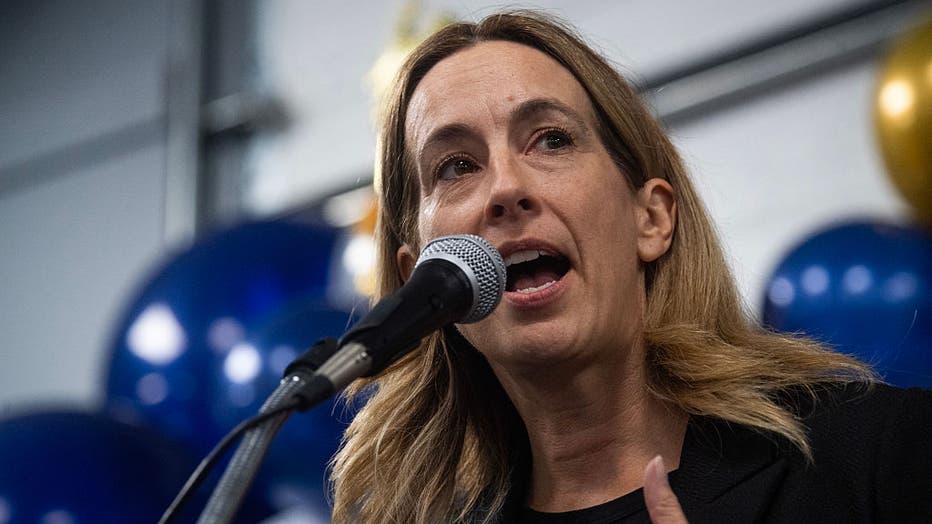
WESTVILLE, NEW JERSEY - OCTOBER 11: Democratic candidate for New Jersey Governor Mikie Sherrill speaks to a crowd alongside Minnesota Senator Amy Klobuchar, in Westville New Jersey on Saturday, October 11, 2025. Sherrill is set to square off against
Jack Ciattarelli (R) calls for reopening power plants, increasing reliance on natural gas and withdrawing New Jersey from the Regional Greenhouse Gas Initiative, which he argues raises electricity costs for residents.
Ciattarelli’s energy platform calls for rolling back several of New Jersey’s clean-energy mandates. He has pledged to end the state’s requirement that all new cars and trucks be zero-emission by 2035.

Republican Jack Ciattarelli responds to questions during the first general election gubernatorial debate with Democratic opponent Mikie Sherrill, Sunday, Sept. 21, 2025, in Lawrenceville, N.J. (AP Photo/Noah K. Murray)
Why it matters to voters
Rising energy costs affect nearly every household and business in New Jersey.
The issue connects to broader debates about cost of living, infrastructure investment and how the state transitions toward cleaner energy sources.
What's next:
Both campaigns have highlighted energy affordability as part of their broader economic messages, and the issue is expected to remain a focus for voters as the November election approaches.
The Source: This article draws on reporting and analysis from FOX 5 NY, FOX 29, NBC News, The New York Times, NorthJersey.com, E&E News, EnergySage and NJ.com, along with prior FOX Local coverage of New Jersey’s political and energy landscape.